
At eight years old, I heard a story that I have never been able to shake.
I was sitting in a pew at First Baptist Church in Canton, Texas. My feet probably did not even reach the floor yet.
A man named John LaNoue stood at the front of the church and told us about something he had prayed for. He talked about God answering prayer as if it had happened last Tuesday.
I had grown up hearing the Bible stories. Noah. Daniel. The loaves and the fishes. I believed them. But somewhere in my eight-year-old mind, I had put those stories in a box marked a long time ago.
John was talking about a God who was doing things now.
“I don’t know a God like that. But I sure want to.”
I didn’t know it then. But I never really put that thought down.
He needed a bus
John was trying to help organize a medical and dental mission along the Texas–Mexico border. The team could take doctors, nurses and dental workers into communities where care was scarce, but moving a temporary clinic from place to place was painfully slow.
So John began thinking about a clinic on wheels.
An old school bus would do.
He made a decision that still gets my attention: he would pray about the need rather than go around asking people for the money.
Then he found a used school bus for sale.
The price was $650. He had $400 available toward it.
He was $250 short.
So he prayed again.
The next morning, a letter arrived from Cecil Worley, John’s former employer in Beaumont—someone John had not expected to hear from. Cecil wrote that he did not fully understand why, but believed God had impressed on him to send John $250.
Exactly what he needed.
John bought the bus.
Getting it home was another adventure. At one point, the bus had essentially no usable brakes. Anyone who knew John would understand why that detail never stopped him for very long.
The prayer became a clinic
The prayer wasn’t the finish line. It was the start of the work.
John and a remarkable collection of ordinary people went to work turning that old bus into a working medical and dental clinic. Welders. Mechanics. Doctors. A dentist. College students. Painters. Businessmen. People who had something useful and were willing to bring it.
The historical record is wonderfully unpolished. There were broken parts, mismatched equipment, late nights, a transmission that did not fit, repairs made by volunteers and a bus being finished almost literally on the way out the door.
That sounds a lot more like real ministry to me than the neat version we sometimes tell afterward.

The first trip south
In June 1967, the Kilgore News Herald documented the clinic leaving Kilgore for the Rio Grande Valley under the headline “Clinic-in-a-Bus Leaves Kilgore For Valley Tour.”
The photograph showed workers around the rear of the vehicle as equipment was being installed. The clinic was dedicated at Los Vecinos Baptist Mission in Harlingen, and on its first operational day the team treated more than 100 people.
That could have been the whole story: one unusual answer to prayer, one old bus, one summer of service.
It wasn’t.
One bus became a pattern
The first bus became a prototype. The idea was simple enough to repeat: take a vehicle that already existed, put useful people around it, turn it into a clinic and take medical care to people who did not have easy access to it.
By the next year, contemporary newspapers were already documenting Amigos Internacionales as an organization built around that mobile-clinic work.
Amigos had become an organization
On July 17, 1968, the Tyler Morning Telegraph announced that an Amigos Internacionales mobile medical and dental clinic would be displayed at First Baptist Church in Tyler before returning to the Rio Grande Valley.
The article identified John as president of Amigos Internacionales and described a clinic equipped with dental chairs and medical equipment. The prayer for one bus was already becoming something larger.


The bus on the road
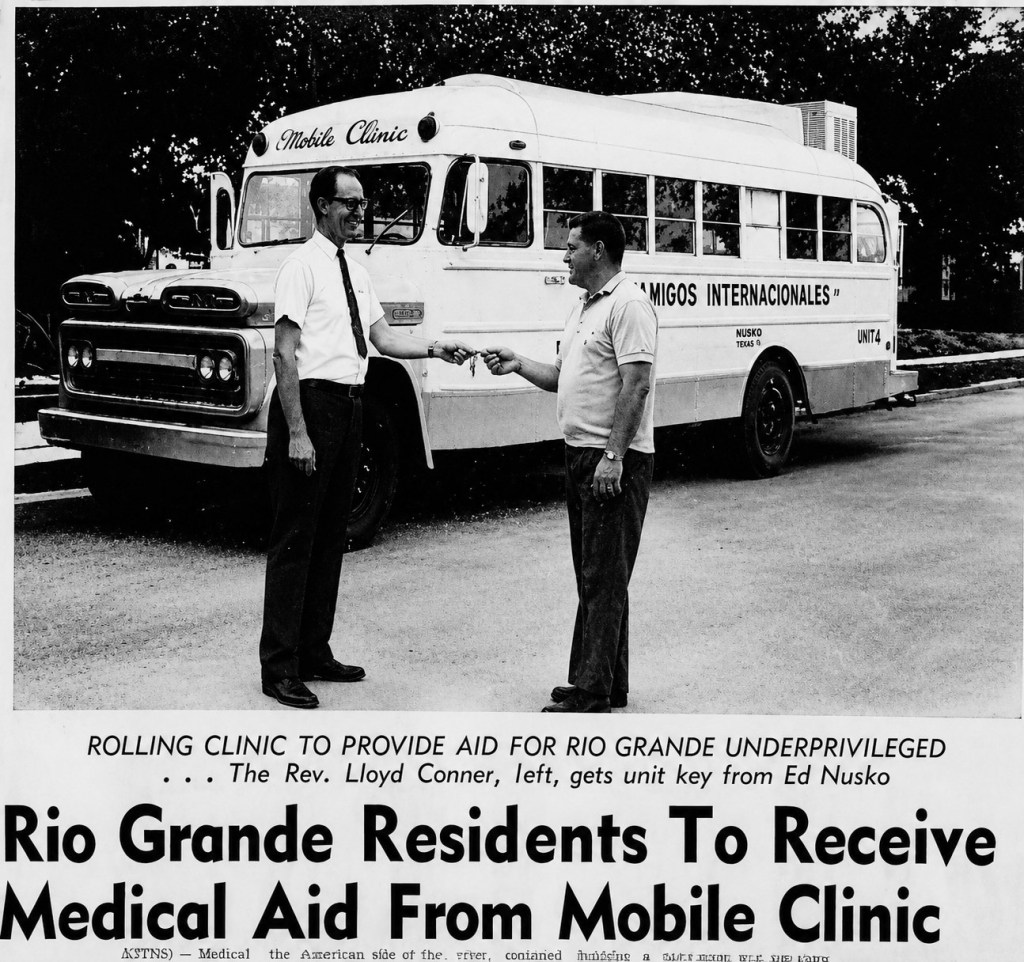
A month later, the San Angelo Standard-Times published a photograph of an Amigos Internacionales bus with the headline “Rio Grande Residents To Receive Medical Aid From Mobile Clinic.”
There it was in black and white: not an idea, not a memory, but a rolling clinic on the road carrying medical care to Rio Grande residents.
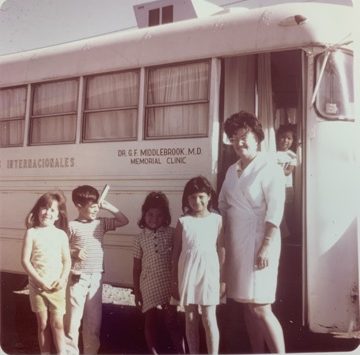
And the pattern kept growing. Over the years, that first clinic led to 11 mobile medical and dental clinic buses.
That matters to me because it changes the way I hear the story now. Cecil Worley did not send money for eleven buses. He sent $250 toward one.
John did not have a fleet plan sitting on the kitchen table. He had a need in front of him and a conviction that God could be trusted with it.
One bus became a clinic. One clinic became a pattern. And that pattern became part of the DNA of Amigos Internacionales.
The newspaper clippings matter because they keep me from turning the story into family folklore. The work happened. People showed up. The buses rolled.
But the bus was not the part that changed me
I want to be careful here, because stories like this can become formulas if we are not careful.
Pray for $250 and a check shows up tomorrow.
That is not what I learned.
I have prayed plenty of prayers that were not answered the way I expected. I have waited. I have misunderstood. I have watched doors close that I was convinced should open.
What changed me that morning in Canton was something deeper.
For the first time I understood that the God I was reading about in Scripture was not simply the God of somebody else’s story.
He was present. And I began to understand that ordinary people could actually walk with Him.
John’s story gave me permission to ask a very different question. Not merely, Do I believe in God?
But, Can I know Him like that?
I have been asking some version of that question ever since.
Almost sixty years later
I could not have imagined where that question would lead.
I certainly did not sit in that pew and picture myself one day helping lead Amigos Internacionales. I did not know one bus would become eleven. I did not see the villages, schools, medical camps, wells, churches, disasters, friendships, disappointments and miracles that would eventually become part of my own life.
I was just a kid who heard a man talk about God as though He were real and near.
And I wanted that.
I still do.
Maybe that is why I keep coming back to this story. The old bus is long gone. The ministry it helped launch has changed more times than I can count. But the question it planted in me remains surprisingly simple.
Do I know God only from the stories I have heard—or am I learning to walk with Him in my own?
That is still the journey.
It started with a prayer for an old yellow school bus.
And I am still asking the question.
You can read more of the documented history at Amigos Internacionales, including the historical record of John LaNoue’s humanitarian work and the preserved account of the early mobile medical ministry.
Historical note: This reflection is based on the story I first heard as a child and later retold at First Baptist Canton in June 2026, together with Dr. John LaNoue’s preserved account of the early mobile clinics and contemporary newspaper documentation from the Kilgore News Herald, Tyler Morning Telegraph and San Angelo Standard-Times. The newspaper records are preserved in the Amigos Internet Archive collection.


Leave a Reply